

 TR
TR DE
DE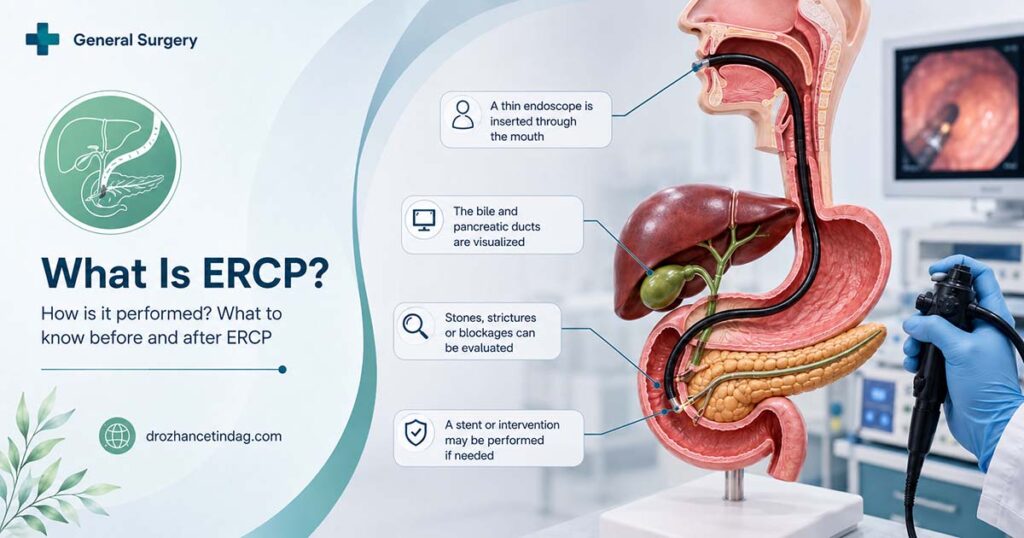
ERCP is an advanced endoscopic procedure used in the diagnosis and treatment of certain diseases affecting the bile ducts and pancreatic ducts. It may be performed in cases such as stones that have passed into the bile duct, strictures, blockages, and some pancreatic duct problems. In this article, you can find clear information about what ERCP is, how it is performed, and what should be considered before and after the procedure.
What Is ERCP?
ERCP stands for Endoscopic Retrograde Cholangiopancreatography. This procedure combines endoscopy and radiological imaging. Its purpose is to evaluate the bile ducts and pancreatic ducts and, when necessary, to allow therapeutic interventions during the same session.
During ERCP, a special endoscope is advanced through the mouth, passing through the esophagus and stomach to reach the duodenum. The area where the bile duct and pancreatic duct open into the intestine is then evaluated. A contrast agent is injected into these ducts, and imaging is performed under X-ray guidance.
This allows evaluation of possible stones, strictures, blockages, leaks, or suspicious masses in the bile ducts and pancreatic ducts.
ERCP is not performed only for imaging. When needed, the following interventions may be carried out during the same session:
- Stones in the bile duct may be removed,
- Strictures may be widened,
- A stent may be placed in the bile duct,
- Tissue samples may be taken,
- Certain problems that obstruct bile flow may be treated.
For this reason, ERCP is a method that can provide diagnostic information and also allow therapeutic interventions.
Is ERCP a Surgery?
ERCP is not a surgical operation. It is performed without making a surgical incision, by advancing through the digestive tract. However, it should not be considered only as a simple imaging test.
ERCP is a specialized procedure that combines endoscopy, radiological imaging, and, when needed, interventional treatment. Since procedures such as stone removal, opening a stricture, or placing a stent can be performed, it should be carried out by experienced teams in properly equipped medical centers.
ERCP is usually performed by gastroenterology and endoscopy teams. In a general surgery evaluation, the overall treatment plan for diseases related to the gallbladder, bile ducts, and pancreas is determined; the need for ERCP is assessed according to the patient’s condition.
In Which Situations Is ERCP Performed?
ERCP is most commonly used in the diagnosis and treatment of diseases affecting the bile ducts and pancreatic ducts. One of the most frequent reasons for ERCP is the presence of stones that have passed from the gallbladder into the main bile duct.
ERCP may be preferred in the following situations:
- Stones in the bile duct
- Bile duct obstruction
- Obstructive jaundice
- Bile duct strictures
- Pancreatic duct strictures or stones
- Suspicion of bile duct or pancreatic tumor
- Bile leakage
- Conditions requiring bile duct stent placement
- Certain cases of pancreatitis
- Some bile duct problems that develop after surgery
When bile flow is blocked, patients may experience abdominal pain, nausea, vomiting, fever, chills, jaundice, dark urine, or pale-colored stools. These symptoms are especially important in terms of bile duct obstruction.
ERCP for Bile Duct Stones
Stones formed in the gallbladder may sometimes pass into the main bile duct. When this happens, bile flow may be impaired and the duct may become blocked. This condition is called a common bile duct stone or choledocholithiasis.
Stones in the main bile duct may cause:
- Pain in the upper right abdomen,
- Jaundice,
- Fever and chills,
- Nausea and vomiting,
- Pancreatic inflammation.
With ERCP, the bile duct can be accessed and stones may be removed in suitable patients. Some stones can be removed using special balloon or basket-like devices, while in some cases the stone may need to be fragmented.
An important point is this: ERCP is generally used to treat stones that have passed from the gallbladder into the main bile duct, not stones located inside the gallbladder itself. The overall treatment plan for gallbladder stones is evaluated separately according to the patient’s condition.
Bile Duct Stricture and Stent Placement
When a stricture develops in the bile ducts, bile cannot flow adequately into the intestine. This may occur due to stones, previous surgeries, inflammatory diseases, or tumors.
During ERCP, the location of the stricture can be identified. When necessary, a stent may be placed in this area to help restore bile flow.
Stents may be plastic or metal. The type of stent used is determined according to the patient’s condition, the cause of the stricture, and the treatment plan. Plastic stents may need to be replaced at certain intervals. For this reason, patients with stents should not miss their follow-up appointments.
ERCP in Pancreatic Diseases
ERCP may also be used in some diseases related to the pancreatic duct. It can help in diagnosis and treatment when there is suspicion of pancreatic duct stricture, stones, leakage, or tumor.
In certain types of pancreatitis, relieving an obstruction in the pancreatic duct may contribute to disease control. However, the decision to perform ERCP in pancreatic diseases should be made individually for each patient.
How Is ERCP Performed?
ERCP is a procedure that requires special equipment. It is usually performed under sedation, deep sedation, or anesthesia. Therefore, patients generally do not feel pain or discomfort during the procedure.
The procedure is generally performed in the following steps:
- The patient is prepared for the procedure.
The fasting period is completed before the procedure. Medications, allergy status, and accompanying diseases are evaluated. - Sedation or anesthesia is administered.
The appropriate method is selected for patient comfort and procedural safety. - The endoscope is advanced through the mouth.
The endoscope passes through the esophagus and stomach and reaches the duodenum. - The opening of the bile and pancreatic ducts is located.
This area is called the papilla. - A contrast agent is injected and imaging is performed.
The bile and pancreatic ducts are evaluated under X-ray guidance. - Therapeutic intervention is performed if needed.
Stone removal, widening of strictures, stent placement, or tissue sampling may be performed during the same session. - The patient is monitored after the procedure.
The patient is observed for a period of time. Depending on the situation, discharge may occur on the same day or hospital monitoring may be required.
ERCP usually takes 30–60 minutes. However, the duration may vary depending on the complexity of the procedure, the condition of the stone or stricture, and the patient’s general health status.
What Should Be Considered Before ERCP?
Preparation before ERCP is important for the safety and success of the procedure. Patients should follow the instructions given by their physician before the procedure.
In general, the following points should be considered:
- Fasting for 6–8 hours is usually required before the procedure.
- All medications being used should be reported to the physician.
- Blood-thinning medications must be mentioned to the doctor.
- Any allergy to medications or contrast agents should be reported.
- Chronic conditions such as heart, lung, kidney, or liver disease should be shared.
- Previous surgeries should be reported to the physician.
- It is recommended to have a companion on the day of the procedure.
Whether blood thinners should be stopped or adjusted is evaluated individually. Therefore, medications should not be discontinued without a physician’s recommendation.
What Is the Recovery Process Like After ERCP?
After ERCP, the patient is observed for a period of time. Since sedation or anesthesia is used during the procedure, the patient may feel sleepy, dizzy, or tired in the first hours.
After the procedure, mild sore throat, bloating, gas, mild abdominal pain, or nausea may occur. These complaints usually decrease within a short time.
On the first day after the procedure, driving, making important decisions, doing heavy work, or staying alone is not recommended. It is safer for the patient to rest and, if possible, have someone nearby.
How Should Nutrition Be After ERCP?
When to start eating after ERCP depends on the patient’s condition and the interventions performed during the procedure. In some patients, liquid foods may be started after short-term observation. In others, longer monitoring may be required.
In general:
- Eating should begin with the physician’s approval.
- Light and soft foods may be preferred.
- Fatty, heavy, spicy, and acidic foods may be avoided for a while.
- If there is throat irritation, very hot, very cold, or hard foods may be avoided.
- If a therapeutic intervention was performed, the nutrition plan may be arranged individually.
The most appropriate nutrition plan after ERCP should be determined according to the recommendation of the physician who performed the procedure.
Are There Any Risks of ERCP?
ERCP is considered a safe procedure when performed by experienced teams. However, like any interventional procedure, it carries certain risks. These risks are not the same for every patient; they may vary depending on age, general health status, accompanying diseases, and the intervention performed during ERCP.
Possible risks after ERCP include:
- Pancreatitis, meaning inflammation of the pancreas,
- Bleeding,
- Infection,
- Injury to the bile ducts or intestine,
- Allergic reaction to the contrast agent or medications used,
- Problems related to sedation or anesthesia,
- Severe abdominal pain,
- Nausea and vomiting.
The likelihood of these risks varies depending on the patient and the procedure. Before the procedure, the patient’s general condition is evaluated and information is provided about possible risks.
When Should a Doctor Be Contacted After ERCP?
Some mild complaints may be expected after ERCP. However, if any of the following symptoms occur, the patient should contact a doctor or the medical center where the procedure was performed without delay:
- Severe and persistent abdominal pain,
- Fever,
- Chills,
- Persistent nausea and vomiting,
- Worsening jaundice,
- Signs of bleeding,
- Black stools or vomiting blood,
- Shortness of breath,
- Palpitations,
- Significant deterioration in general condition.
These symptoms may indicate conditions such as pancreatitis, infection, bleeding, or a bile duct problem.
What Is the Difference Between ERCP and MRCP?
ERCP and MRCP are two different methods used to evaluate the bile ducts and pancreatic ducts. However, their purposes and methods of application are different.
MRCP is a non-invasive imaging method performed using magnetic resonance imaging. No endoscope is inserted into the body. It is generally used for diagnostic purposes.
ERCP, on the other hand, is an interventional procedure that combines endoscopy and radiological imaging. Its most important difference is that treatment can be performed during the same session when necessary. For example, a stone in the bile duct can be removed, a stricture can be opened, or a stent can be placed.
In summary:
- MRCP is mostly used for diagnosis.
- ERCP can be used for both diagnosis and treatment.
- MRCP is non-invasive.
- ERCP is an interventional procedure and may carry certain risks.
The choice of method is determined according to the patient’s symptoms, blood tests, ultrasound, CT, MRI findings, and general health status.
Frequently Asked Questions About ERCP
How long does ERCP take?
ERCP usually takes 30–60 minutes. However, the duration may be longer if additional procedures such as stone removal, stent placement, or opening a stricture are performed.
Is the patient sedated during ERCP?
ERCP is usually performed under sedation or anesthesia. Therefore, the patient generally does not feel pain or discomfort during the procedure. The method used is determined according to the patient’s general health status and the scope of the procedure.
Is ERCP painful?
Since the patient is under the effect of sedation or anesthesia during the procedure, pain is not expected. Mild sore throat, bloating, or mild abdominal pain may occur afterward.
Is hospitalization required after ERCP?
Some patients may be discharged after short-term observation. However, hospitalization may be required depending on the patient’s general condition or if procedures such as stone removal, stent placement, or a higher-risk intervention are performed.
Can bile duct stones be removed with ERCP?
Yes. In suitable patients, stones that have passed from the gallbladder into the main bile duct may be removed with ERCP. This can help relieve bile duct obstruction.
When can eating begin after ERCP?
The timing of eating varies from patient to patient. In general, liquids and light foods may be started after physician approval. If a therapeutic intervention was performed, the nutrition plan may differ.
Why is a stent placed during ERCP?
If there is a stricture or blockage in the bile duct or pancreatic duct, a stent may be placed to restore flow. The aim is to allow bile or pancreatic fluid to drain appropriately.
What should patients with a stent pay attention to after ERCP?
Patients with stents should not miss their follow-up appointments. Plastic stents in particular may need to be replaced at certain intervals. If fever, chills, jaundice, or abdominal pain develops, a doctor should be contacted.
General Overview of ERCP
ERCP is an important method in the diagnosis and treatment of many diseases affecting the bile ducts and pancreatic ducts. It may provide both diagnostic and therapeutic benefit, especially in cases such as stones in the bile duct, obstructive jaundice, bile duct strictures, and some pancreatic duct problems.
Whether ERCP is necessary should be determined by evaluating the patient’s symptoms, examination findings, blood test results, imaging findings, and general health condition together. Therefore, the decision for ERCP should be planned individually by the relevant specialist physicians.
